
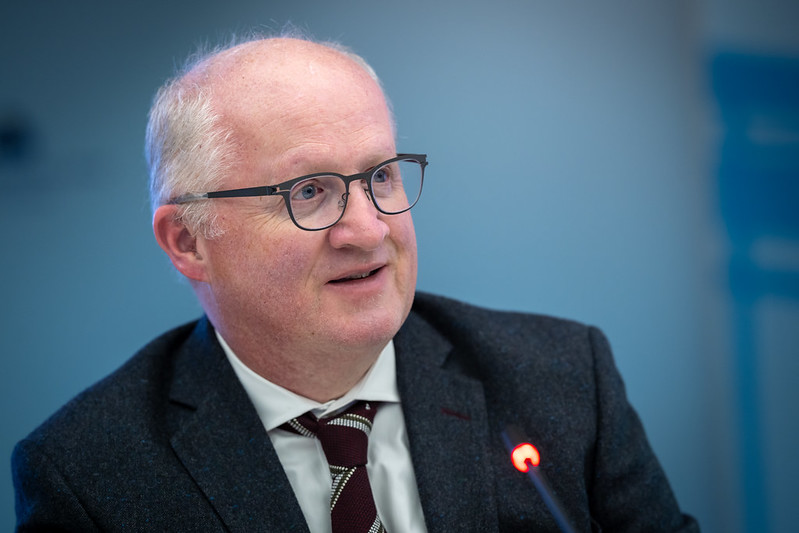
By David Barwick – GENEVA (Econostream) – European Central Bank Chief Economist Philip Lane said Wednesday that coming interest-rate decisions could prove less straightforward than September’s 25bp hike, as policymakers weigh a more persistent energy shock against limited second-round effects, stronger-than-expected economic activity and tightening financial conditions.
“Let’s see, as we go into the meetings in the rest of this year and into next year, whether every decision will be so straightforward,” Lane said. “We don’t always have a situation where the decisions are straightforward. Sometimes it’ll be a balancing act.”
The September increase in the deposit rate from 2.25% to 2.50% had been relatively easy to decide, Lane said, echoing President Christine Lagarde’s characterization of the move as a “no-brainer.”
“What we had going into September, you didn’t have to think very hard to say going from 2.25 to 2.50 was a reasonable decision,” he said.
At the same time, simply waiting for an expected decline in energy inflation without taking any monetary policy action would have carried excessive risks, according to Lane.
“On a risk-management basis, I think it’d be excessively brave to do nothing,” he said. “So having a moderated response, which is what we’ve been doing, is important.”
The energy shock confronting the euro area had grown larger and more persistent than expected earlier in the year, although market pricing continued to point to an eventual reversal, Lane said.
“Energy prices right now look like they’re tracking the adverse scenario until the middle of 2027, and then they fall back towards the baseline,” Lane said. “So that’s kind of in between the baseline and the adverse, as of yesterday’s data.”
“It’s not the severe scenario and it’s not the milder scenario,” he added. “But again, the volatility in energy markets coming from geopolitics does mean this can move around.”
Refining constraints had meanwhile become an important additional source of near-term fuel inflation, with damaged capacity contributing to higher margins for refined products rather than the rise coming solely from crude prices, Lane said.
“It’s inflationary for the next few months, disinflationary later on,” he said, adding that some improvement in refining capacity during 2027 was embedded in market forward curves.
The ECB’s September projections incorporated 0.2 percentage point more inflation this year than the June forecast on a 4Q-on-4Q basis, an adjustment Lane said was meaningful in monetary policy terms.
“The typical person might say 0.2 doesn’t sound very much, and of course it isn’t,” he said. “But from an interest-rate point of view, 0.2 is relevant when the typical interest-rate increment is 0.25.”
Despite the upward revision for 2026, the ECB had not changed its view of 2027 because energy prices were still expected to decline, Lane said.
“Maybe what I’ll emphasize is we didn’t change our view about what happens next year,” he said. “Because in 2027 it remains the case that, we think, there’ll be some recovery, some decline in energy prices.”
The picture outside energy was more benign than in June, he said.
“Importantly, when we kick out energy and say, well, what’s happening to everything else, we had a downward revision,” Lane said.
A central concern since the Middle East conflict began had been whether higher energy prices would spread into food, goods and services inflation, he said, but the evidence so far had been relatively favorable.
“We’re concerned if the rise in energy prices drives up food prices, drives up goods prices, drives up services prices,” Lane said.
Food inflation in particular had undershot expectations despite earlier concern that higher fertilizer prices would push it up.
“We had concerns that high fertilizer prices and so on would push up food prices,” he said. “It turned out over this period food inflation came in very low.”
Lane said the same applied to concerns about an energy price shock feeding into wages.
“Another concern was: if workers see prices going up, they look for higher wages,” he said. “We allowed for that already in March and June. We didn’t particularly think that effect was getting stronger. We think it’s going to happen to some extent, but essentially we think it’s quite limited.”
An upward revision to compensation per employee for 2027 and 2028 reflected the stronger economy more than additional pass-through from energy prices into wages, Lane said.
“If the economy is not strong, a firm may have higher costs because of energy, but that firm is not going to be able to convince its customers to pay a higher price,” he said. “It will have to eat the higher cost in terms of lower margins and so on. So the strength of the economy is important.”
Lane said the ECB, market participants and professional forecasters broadly agreed that inflation was currently too high but would lose much of its excess during 2027.
“The market now has a higher peak than we do, and it’s still falling back over the course of next year to 2%,” he said. “So there’s a consensus among experts, among market traders, among us, that essentially we do have inflation well above the target, but over the course of next year a lot of that excess should fade away.”
Longer-term inflation compensation remained comparatively stable, with a recent rise in the five-year, five-year measure appearing mainly attributable to risk premia rather than a substantial change in expected inflation, he said.
Food-price developments illustrated the uncertainty surrounding projections, Lane said, recalling widespread expectations only months ago that fertilizer costs would lead to materially higher food inflation.
“A lot of people were writing there’s going to be higher food inflation because of fertilizer prices,” he said. “That was very widely held.”
While the ECB still expected food inflation to increase, the outturn had been considerably more benign than projected in June.
“That’s a pretty big difference in the space of three months,” Lane said.
Severe weather during the summer had not erased favorable agricultural conditions earlier in the year, he said.
“Yes, this summer had droughts, severe weather, but the spring actually was quite good for agricultural production,” Lane said, adding that “sky-high prices invite farmers to produce more.”
The euro area economy had likewise performed better than anticipated, prompting an upward revision to 2026 GDP but no corresponding upgrade to 2027 or 2028, Lane said.
“We did revise our view for GDP this year, but not for next year or the year after,” he said. “That’s essentially coming from Q2 being better than expected.”
The upward surprise was broad-based across consumption, government spending, investment and international trade and had occurred “for different reasons, across different categories of spending,” he said.
Household consumption had proved more resilient partly because the energy shock, fertilizer costs and overall inflation had been less severe than feared, leaving households with more purchasing power.
“One version is households turned out to have more money in their pocket,” Lane said. “Inflation did not erode their real incomes as much as we expected, and that’s a very simple story about consumption.”
A separate global argument linked strong consumption to the AI-related equity boom and rising household wealth, but Lane said that channel appeared considerably weaker in Europe than in the United States.
“Yes, Europeans do own lots of Nvidia shares and so on, but nothing like the scale of what American households own,” he said. “So we don’t particularly think the wealth effect is super-strong in Europe, even though it’s pretty strong in the US.”
The labor market remained characterized by low unemployment, but demand for workers had cooled, limiting the scope for aggressive wage bargaining, Lane said.
“The strength of the labor market basically depends on labor demand,” he said. “If firms don’t want to hire a lot of workers, they’re not going to be overly aggressive in wage deals.”
Analysis of company earnings calls suggested hiring intentions had fallen to an index level of around 90 from 100 in 2025, he said.
“They’re at 90 now — much less interested in hiring, given the uncertainty about AI and other factors,” Lane said. “It’s not super-hot in terms of hiring, and also creeping up — less so, but creeping up — is thinking about shedding labor as well.”
Asked later about wage behavior, Lane said the ECB’s wage tracker showed little evidence so far of the energy shock triggering a substantial response.
“We’re not seeing any big response to the energy shock,” he said.
Workers were aware that living costs were rising faster than expected but also faced constraints from international competition and technological substitution, he said.
“A lot of firms are saying, ‘Look, we’re being outcompeted by China.’ You do know, if you ask for too much, we have the AI robots ready to go,” Lane said. “So the ability of converting your perceived inflation into an actual wage increase is less.”
The pricing environment also differed from 2022, when the post-pandemic reopening generated unusually strong consumption even as Russia’s invasion of Ukraine drove energy prices sharply higher, Lane said.
“There was very strong consumption, because people said: okay, I’m turning off the news, I’m going on holiday; I’m turning off the news, I’m going to a restaurant,” he said.
“That’s not true now. So this year there’s not a party mood, if you like, in consumers.”
World trade had meanwhile considerably exceeded expectations, with growth now seen around 4.5% compared with an estimate of around 2% six months earlier, Lane said.
“That’s a really big difference,” he said, adding that the euro area had benefited sufficiently for the ECB to revise up its 2026 export outlook, although not its view of 2027 and 2028.
AI was a major reason for the trade strength because it was “a super-globalized sector,” Lane said, pointing to US data-center construction, Asian semiconductor production and European suppliers including ASML and Zeiss.
The stronger-than-expected economy also reflected fiscal policy, Lane said, with the euro area fiscal impulse this year now estimated at around half a percentage point of loosening compared with roughly 0.25 point expected in December.
But much of that support would reverse in the following two years as the European Union’s Next Generation EU program winds down, he said.
“A lot of that is given back in ’27, ’28,” Lane said. “Remember, Europe as a whole, Next Generation EU finishes this year.”
Large recipient countries including Spain and Italy were currently spending substantial sums that would not continue at the same rate next year, he said.
“So there’s going to be a turnaround in the contribution of fiscal policy, and this could be one reason why we upgraded 2026 GDP,” Lane said. “We did not upgrade what’s going to go on next year and the year after.”
Public investment growth could fall from around 5% this year to a rate in the 2% range next year and around 1% in 2028, he said.
“If you travel around Europe and look at the projects that are going on — construction, lots of investment projects — this is a tailwind now but a headwind in ’27, ’28.”
Financial conditions were also tightening for reasons extending beyond the ECB’s own rate increases, Lane said, underscoring that the appropriate policy response could not be inferred from the policy rate alone.
“What you see this year is conditions are tightening, and it’s not just because we’ve raised the policy rate; these other factors are tightening as well,” he said.
Euro area 10-year rates had risen around 60bp this year, reflecting both higher expected rates and an increased term premium, while bond-market funding had become more expensive for banks and companies, Lane said.
“When we try to think about where the policy rate should go, it’s relevant to take into account — which our forecast does — the long-end tightening, the tightening in financial conditions,” he said. “How much is that slowing down the economy and how much does that reduce inflation?”
Those effects were material for monetary policy, he said.
“If the market is tightening for additional reasons, that will be disinflationary,” Lane said. “It will slow down the economy.”
Market pricing nevertheless pointed to a higher policy rate path than previously, Lane said. Stripping risk premia out of market pricing suggested a peak rate of around 3%, followed by some decline next year, though he stressed that the ECB would not mechanically follow market expectations.
“We always find it interesting: why does the market think that?” he said. “But in the end we will make our own decisions.”
Lane said the ECB’s data-dependent approach required looking not only at headline inflation but at whether underlying inflation was broadening through the economy, alongside growth and the strength of monetary-policy transmission.
“What we say is our decisions will be data-dependent,” he said. “Then we will be looking at inflation — and again, not just the latest inflation number. Importantly, underlying inflation. So, looking: is it spreading out? Is it broadening across the economy? What’s happening to GDP? Because medium-term inflation is connected to GDP. And the strength of monetary-policy transmission.”
“Once you look at the inflation data, the economic data, the financial data, it’s not that hard to make a decision,” he added.
Lane also highlighted uncertainty surrounding low European gas inventories heading into winter, saying firms appeared reluctant to replenish them at current prices because they expected prices to fall.
“The firms involved are saying: ‘I’m not willing to buy at the current high price. I think the price will fall,’” he said.
Such a strategy involved risk, however.
“That’s a judgment call,” Lane said. “It may be the wrong judgment call.”
Turning to defense, Lane said existing spending was already supporting activity but had so far had little inflationary impact.
“Current defense spending is making a visible contribution, and inflation is still pretty small,” he said.
A move to defense spending equivalent to 5% of GDP would be materially different, however.
“If you move to hitting the 5% target, that would be a big shock,” Lane said, adding that the economic consequences would depend in part on how the additional spending was financed.
Greater use of renewable energy had meanwhile helped limit the severity of the current energy shock compared with what might have occurred several years ago, Lane said.
“Compared to five years ago, there’s a lot more renewables in electricity production here,” he said. “One reason why the shock is not so severe is there has been a lot of progress on renewables. I think that that is important.”
On physical climate risks, Lane said individual regions could experience significant economic damage but national economies tended to adapt over time, limiting the aggregate effect.
“You can find, and we do find, visible effects on GDP at a regional level, hardly anything at a national level, because countries adapt,” he said.
Climate-related events could nevertheless generate considerable price volatility, Lane said, while stressing that such volatility did not necessarily imply permanently higher inflation.
“More volatile doesn’t mean higher trend inflation,” he said. “But it does mean you have to explain volatility — to explain to markets and to people: here’s why we think it’s a volatility event, it’s not a trend event.”
Summing up the economic picture, Lane said the euro area had enjoyed more favorable developments over the summer than expected, but renewed energy volatility and geopolitics left the outlook highly uncertain.
“We had a good summer, inflation less than expected, GDP more than expected,” he said. “But there’s a lot of movement now in energy prices. But equally, there’s a lot of geopolitics, political diplomacy going on, and let’s see what happens.”
- The author of this story can be contacted at david-barwick@econostream-media.com