
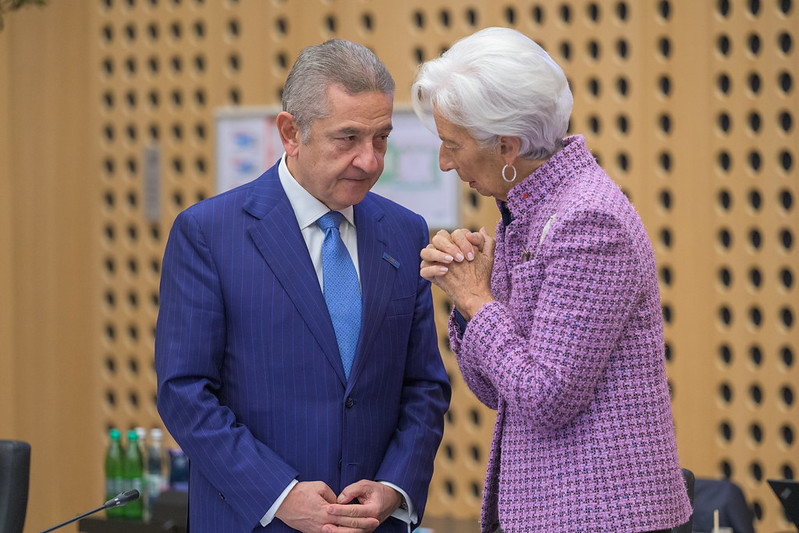
By Marta Vilar – MADRID (Econostream) – European Central Bank Governing Council member Fabio Panetta said on Monday that central banks should give greater weight to actual developments in demand, activity and inflation than to estimates of the neutral interest rate as artificial intelligence makes key economic relationships harder to gauge.
Speaking virtually at the 10th annual research conference of the National Bank of Ukraine and the Narodowy Bank Polski, Panetta, who heads the Banca d’Italia, said that “[i]n an environment of rapid structural change, where unobservable variables are particularly difficult to estimate, actual developments in demand, economic activity and inflation should carry greater weight in guiding monetary policy than estimates of the neutral rate.”
He said the implications of AI for the neutral rate remained ambiguous, as the upward pressure from stronger productivity could be counteracted by shifts in saving behavior and income distribution.
AI-related investment was already providing a “powerful boost” to demand, particularly in economies at the technological frontier, while increasing demand for computing capacity, energy, specialized labor and other scarce inputs.
“Until supply catches up, these pressures may push up relative prices and inflation,” he said.
The eventual inflation impact would depend partly on how AI affects labor markets and how its productivity gains are distributed, according to Panetta.
If AI creates new tasks, raises expected labor income and strengthens consumption, demand could increase before the full productivity benefits materialize, meaning “inflationary pressures could persist for longer,” he said.
If automation instead increases uncertainty over jobs and wages, Panetta said households could save more and consume less, allowing AI’s disinflationary effects to emerge sooner.
Differences in AI adoption across economies could also affect monetary policy through trade, capital flows and exchange rates, he said, warning that exchange rates could become more volatile during the transition.
- The author of this story can be contacted at marta.vilar@econostream-media.com