
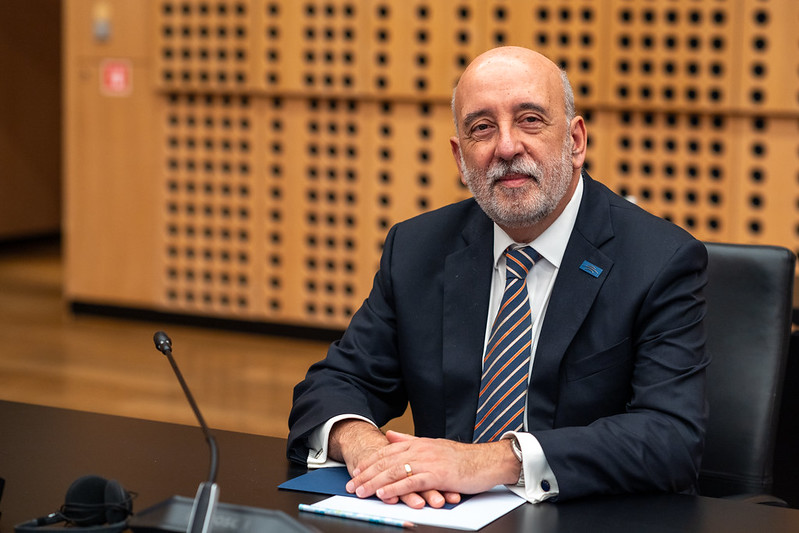
By David Barwick – FRANKFURT (Econostream) – European Central Bank Governing Council member Gabriel Makhlouf said Friday that he supported Thursday’s 25bp rate increase because inflation remained above target with upside risks, core inflation had yet to ease decisively and growth had remained resilient, while warning that substantially more tightening could impose meaningful economic costs.
“The balance of these signals – inflation above target with upward risks, core inflation not yet decisively easing, and resilient growth – suggest a 25bp increase in rates as measured policy response,” Makhlouf, who heads the Central Bank of Ireland, wrote in a blog.
Makhlouf said the rebound in energy prices had persisted rather than faded, with euro area headline inflation rising to 3.3% in August from 2.9% in July.
“Clearly, energy prices have not faded and, if anything, are proving stickier than previously thought,” he said.
Core inflation had been more stable, easing slightly to 2.4% in August as services inflation softened, Makhlouf said.
He said wage adjustment to the inflation shock was likely to occur with a significant lag, with wage growth of 3.3% in the second quarter broadly in line with expectations and near-term indicators pointing to stabilisation around that level.
“The delayed pass-through of the energy shock is likely to set a floor on wage growth this year and next,” Makhlouf said.
The ECB’s September projections assumed average wage growth of 3.3% in both 2026 and 2027, with second-round effects through wages remaining contained in the baseline, he said.
The adverse and severe scenarios incorporated stronger second-round effects and higher inflation, while a milder scenario assumed a faster normalisation of energy prices, Makhlouf said.
So far, the inflation shock had mainly been visible through the direct effects of higher energy prices, he said, while indirect effects through supply chains and firms’ costs were expected to emerge only gradually in non-energy inflation.
The current projections nevertheless envisaged smaller indirect effects than during the 2021-24 inflation episode, Makhlouf said.
He added that climate-related factors, including El Niño, could generate additional upward pressure on food inflation in the coming months.
Makhlouf said the ECB’s September projections had revised the inflation path upward from June and pushed the return to the 2% target further into the medium term.
Growth had meanwhile proved resilient despite the energy shock, higher inflation and tighter monetary policy, with the latest projections putting euro area GDP growth at 0.9% in 2026 and 1.4% in 2027, he said.
Looking ahead, Makhlouf stressed the high degree of uncertainty surrounding the outlook.
“The near-term driver of elevated inflation remains energy: a geopolitical driver more than economic one,” he said.
“A drawn-out conflict in the Middle East risks keeping inflation elevated for a long period,” Makhlouf said.
“But the other side of uncertainty is that raising rates a great deal more from here could carry real costs in terms of growth,” he said.
Financing conditions were already tightening because of monetary policy and other factors, while the labour market was cooling and demand conditions were weaker than in 2021-22, Makhlouf said.
He said the ECB should avoid pre-committing to a particular rate path and continue to assess policy meeting by meeting.
Makhlouf said he would focus in particular on the persistence of the energy shock, its direct and indirect impact on consumer prices, wage dynamics and the transmission of previous policy moves.
“The Governing Council’s meeting-by-meeting approach, is precisely to gather this evidence,” he said. “It is the appropriate response to uncertainty about the magnitude and persistence of the shock we are managing.”